Bioprocessing (English only)
Find the perfect Ecolab
resin for your monoclonal
antibody purification needs.

Find the perfect Ecolab
resin for your monoclonal
antibody purification needs.
私たちは樹脂技術のグローバルリーダーとして、世界で最も規制の厳しい産業で、非常に特殊な元素や化合物を分離、除去、回収するために使用される小型ビーズを開発・製造しています。
もっと読む
With 40 years of manufacturing expertise and 30 years of regulatory experience, we supply leading separation, purification and extraction technologies to support chromatography applications within the Pharma and Medical space.
Learn more
We are a world leader in resin-based separation, purification and extraction technology, that provides sustainable solutions for our environment, businesses and healthcare.
Learn More
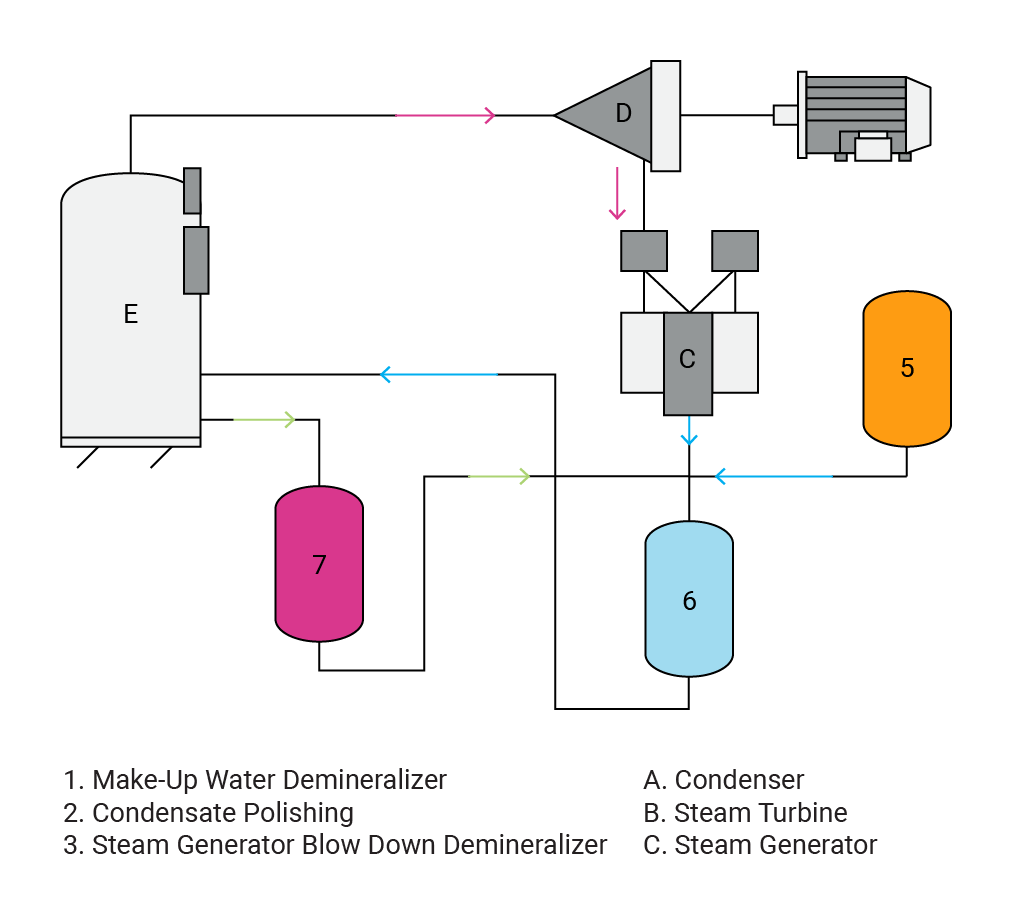
Ion exchange treats three circuits within the secondary circuit in a pressurized water reactor (PWR) nuclear plant. They are makeup water, returned condensate and steam generator blowdown. The secondary water circuit generates steam which is fed directly to the turbines and is non–radioactive. The system feed water consists of condensate return, steam generator blowdown, and demineralized makeup. This water must have high purity. During full power, the makeup water system will compensate for blowdown losses and any possible leaks.
Makeup Water Treatment
Many makeup water treatment systems have moved to build, own and operate (BOO). This generally consists of clarification or ultra-filtration (UF), carbon filters, reverse osmosis (RO) technology, electronic deionization (EDI), followed by polishing using mixed bed ion exchange systems. When resins treat makeup water, they must be highly regenerated and specially processed to meet tight specifications for chloride, sulfate, sodium, iron and TOC (also known as purgeable organic carbon (POC)). NRW3240 can be used as a polisher in makeup systems. This mixed bed resin is composed of resins that are characterized by high total capacity and selectivity for influent cations such as sodium, and anions such as silica and chloride. This resin is also easily regenerated to a high level of conversion with minimal release of impurities.
As a final polishing step before the water enters the deionized water storage tank (DWST), a non-regenerable, high-purity mixed bed resin, such as UltraClean™ UCW9964, may be used. For a “less separable” mixed bed, UCW9966 can also be used. The makeup water quality will achieve 17.9 MΩ, residual silica < 2 ppb, residual sodium < 0.02 ppb, residual TOC < 1.5 ppb. When the final polishing UCW mixed bed is removed from service, it can be used as a regenerable resin elsewhere in the plant, but not returned to final polishing.
When makeup water is from a surface water source, it may contain colloids, especially colloidal silica. Colloidal silica is difficult to remove by conventional filtration and ion exchange. NRW5010 effectively removes colloidal silica from water and prevents it from entering the steam generator. This targeted treatment step is best used in a stand-alone vessel following filtration pretreatment and regeneration with caustic.
Condensate Polishing
Treatment of condensate is essential for extending steam generator life. The goal is to remove iron and other corrosion elements to prevent deposits in the secondary circuit. In general, secondary chemistry is tightly controlled to maintain measurable iron levels below 0.8 ppb. Polishing resins are operated at high flow velocities up to 122 m/h (50 gpm/ft2). They are expected to remove ions such as sodium, chloride and sulfate to << 3.0 ppb in the steam generator.
There are different ways to control secondary corrosion:
Secondary circuits are conditioned with hydrazine to remove trace oxygen.
Condensate and steam generator water pH is maintained within a range of 8.8 to 10.5 using amines such as monoethanolamine (ETA).
Although favorable in reducing corrosion, this amine chemistry approach is suspected of negatively impacting condensate polishing resins by drawing foulants from the cation resin, fouling the anion resin and reducing kinetics. When anion resin becomes kinetically impaired, sulfate levels begin to increase in the steam generator.
Condensate polishing, which removes corrosion products and in-leakage, is accomplished primarily with deep mixed bed polishers. When plants use freshwater for cooling, deep-bed condensate polishers are operated during startup or upset conditions. When plants are cooled with brackish or saltwater, the deep beds are operated continuously. Care is required to ensure that the steam generator receives high-purity water containing < 0.02 ppb of Na+, Cl-, and SO4-, as these dissolved solids will concentrate in the steam generator contributing to intergranular and stress corrosion. The level of purity required from the polishing resin is critical. Although regeneration may be done for condensate polishing resins and steam generator blowdown, systems operating past a conductivity or amine break do not regenerate. Achieving regenerated levels where sodium, chloride and sulfate do not leach is often difficult. Special efforts must be taken to ensure proper separation of resins, minimizing cross-contamination of regeneration chemicals. These specific ions include Na+ on the strong acid cation and sulfate on the anion resin.
Deep-bed demineralizer resins for condensate polishing
Non-regenerable polishers will use the strong acid macroporous cation exchanger NRW160LS, or gel NRW 1160LS, in the complimentary mixed bed NRW3560LS, or NRW3675LS. This system consists of service vessels filled 3-4 feet deep with mixed bed resin. This resin removes unwanted cations, corrosion products, ammonia, amines and traces impurities, supporting longer unit run times and operates generally to a predetermined service life or sodium break whichever occurs first.
A non-regenerable mixed bed with 1:1 cation-to-anion ratio by volume addressing elevated amine chemistries is NRW3561LS or 2:1 cation to anion by volume NRW3562LS.
Regenerable mixed bed polishing resins include the strong acid cation SGC650 and the strong base anion gel SGA550.
Regenerable resins above generally require the service cycle to stop at the ammonia break resulting in approximately 2-4 weeks service.
Precoat filters are coated with a mixture of strong acid cation exchanger in H+ form (Microlite® PrCH) or an ammonia-form exchanger (Microlite PrCN) and a strong base anion exchanger in OH- form (Microlite PrAOH). Precoat filters have a relatively limited capacity for removing soluble salts and thus become rapidly exhausted in the event of a condenser leak.
Powdered resins have an inherent advantage over bead resins in that they have less capital cost associated with precoat facilities than a regeneration system. Filtration of corrosion products is more efficient with powdered resins. Precoat products are available premixed as mixed bed products, without fiber (Microlite® MB) and with fiber (CG range).
Steam Generator Blowdown Treatment
The steam generator blowdown demineralizer (SGBD) must maintain water quality within specified Electric Power Research Institute (EPRI) Secondary Water Chemistry Guidelines. SGBD is designed to remove and control dissolved solids in the steam generator. Demineralized blowdown is typically returned to the condensate storage tank (CST), where it contributes to makeup water.
A blowdown demineralizer system generally consists of two vessels: a strong acid cation exchange resin in the lead vessel and a mixed bed of strong acid cation and strong base anion in the second vessel. This system can operate the lead cation past the amine break and possibly to a sodium break as long as sodium on the cation (and anion) is low (< 10mg/Kg). Blowdown resins like condensate resins require high purity cation and anion resins. High-capacity cation resins are generally macroporous NRW160LS or gel NRW1160LS. The mixed bed will operate past the amine break to a sodium break depending on operating conditions. The run time may be as long as six months. This practice is more common with the steam generator blowdown demineralizer.
High cross-linked macroporous cations resins operated in the low sodium form will result in only a slight sodium excursion when the amine break is reached. Low-level sodium released from the lead cation will be removed by the downstream mixed bed (NRW3560LS or NRW3675LS). The mixed bed following the cation bed may also be operated past an amine break to a sodium break.
However, the sodium break is much sooner (typically occurring in a matter of weeks) compared to what is often experienced on the cation bed (several months). For plants with higher ammonia and amine levels, use of a layered bed with a higher cation capacity (NRW160LS or NRW1160LS) layered on top of the mixed bed (NRW3560LS). This layered bed will consist of 50% cation on top of the 50% mixed bed, providing approximately 4.0:1 equivalence cation-to-anion.
