Affinity Resin Selector
Find the perfect Ecolab
resin for your monoclonal
antibody purification needs.

Find the perfect Ecolab
resin for your monoclonal
antibody purification needs.
En tant que leader mondial de la technologie des résines, nous développons et fabriquons de petites billes qui sont utilisées dans les industries les plus réglementées au monde pour séparer, éliminer ou récupérer des éléments et composés très spécifiques.
Apprendre encore plus
Avec 40 ans d'expertise en fabrication et 30 ans d'expérience en réglementation, nous fournissons des technologies de séparation, de purification et d'extraction de pointe pour soutenir les applications de chromatographie et de biocatalyse dans les soins de santé et les sciences de la vie.
(Pages Sciences de la vie actuellement en anglais uniquement)

Nous sommes le leader mondial des technologies de séparation, de purification et d'extraction à base de résine, qui fournissent des solutions durables pour notre environnement, nos entreprises et nos soins de santé.
Learn More
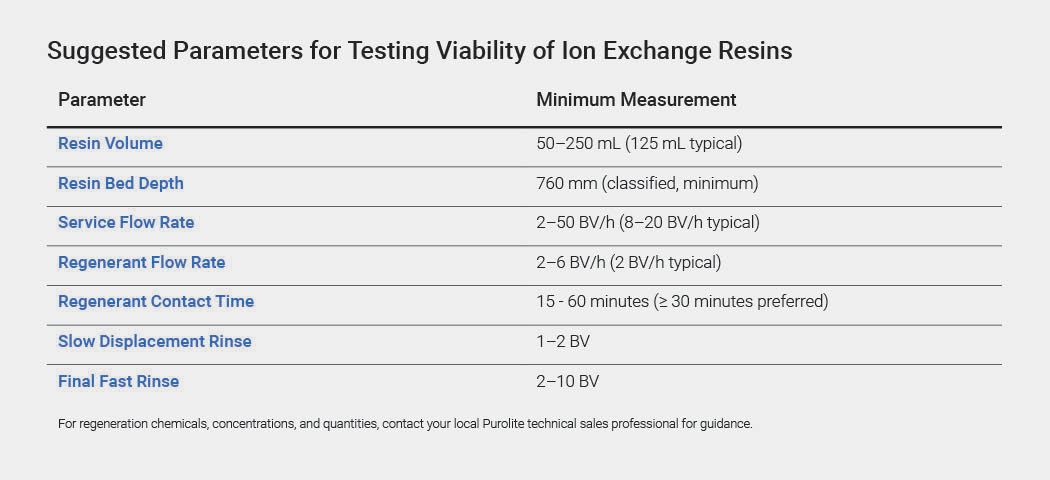
Depending on the application, the process conditions for the resin will vary widely. For processes that are not fully developed, discovering and maintaining the optimum specific flow rate will be one of the primary objectives of the laboratory study.
Flow Rates
Typical flow rates are 8-40 bed volumes per hour (BV/h) depending on the ionic concentration of the solution. In many aqueous applications where the impurity concentration is small and conventional ion exchange occurs, flow rates through the resin may be as high as 50 BV/h. In special process applications, or where highly selective removal is required, flow rates usually are much lower, between 1-10 BV/h.
Regeneration
Resin regeneration is typically carried out at relatively low flow rates of 1–6 BV/h to achieve maximum removal from the beads. A slow rinse follows this process at a similar flow rate to maximize the removal of the regenerant. The final rinse is carried out using a similar flow rate to the in-service flow rate.
Preparing the Resin Sample
Storage and Preconditioning
Before running a laboratory test, the sample needs to be conditioned to ensure full swelling and hydration of the resin. Unless otherwise advised, the resin must be soaked.
When samples are sent out from Purolite, the resin is taken directly from production batches or warehouse stock. If the resin is stored before testing, make sure the containers are not left open to the atmosphere or allowed to dry out. Keep resin storage containers away from strong sunlight and hot or cold temperatures.
Ion exchange resin stored for any length of time will require rinsing with demineralized water to reduce leachables before trials can be performed. In many applications, 5–10 bed volumes should be sufficient. High-purity applications may require different preparation. Please contact your regional Purolite sales office for assistance.
Resin Volume
Approximately 370-380 ml of resin is sufficient for an initial test of a single resin bed. If the inlet load is very low, it will require a large amount of solution to be processed through the bed to reach exhaustion and greatly increase the time it takes to complete each test.
Loading
Fill 1/2 to 1/3 of the column in advance with deionized water, then transfer the pretreated ion exchange resin into the column. Maintain a minimum total bed depth of 760 mm (372 ml in described apparatus) for the trial. In most applications, the process will improve if the bed depth is increased. Do not load ion exchange resin into a dry column. Do not use the above procedure for mixed beds.