Affinity Resin Selector
Find the perfect Ecolab
resin for your monoclonal
antibody purification needs.

Find the perfect Ecolab
resin for your monoclonal
antibody purification needs.
As a global leader in resin technology, we develop and manufacture small beads that are used in the most regulated industries in the world to separate, remove or recover very specific elements and compounds.
Learn More
With 40 years of manufacturing expertise and 30 years of regulatory experience, we supply leading separation, purification and extraction technologies to support chromatography applications within the Pharma and Medical space.
Learn more
We are a world leader in resin-based separation, purification and extraction technology, that provides sustainable solutions for our environment, businesses and healthcare.
Learn More
| Polymer Structure | Gel polystyrene crosslinked with divinylbenzene | |
| Appearance | Spherical Beads | |
| Functional Group | Type I Quaternary Ammonium | |
| Ionic Form | Cl- form | |
| Total Capacity (min.) | 0.8 eq/L (17.5 Kgr/ft³) (Cl- form) | |
| Moisture Retention | 60 - 65 % (Cl- form) | |
| Mean Diameter | 650 ± 50 µm | |
| Uniformity Coefficient | 1.1 - 1.2 | |
| Reversible Swelling, Cl- → OH- (max.) | 35 % | |
| Specific Gravity | 1.04 | |
| Shipping Weight (approx.) | 670 - 705 g/L (41.9 - 44.1 lb/ft³) | |
| Temperature Limit | 100 °C (212.0 °F) (Cl- form) | |
| Temperature Limit | 60 °C (140.0 °F) (OH- form) | |
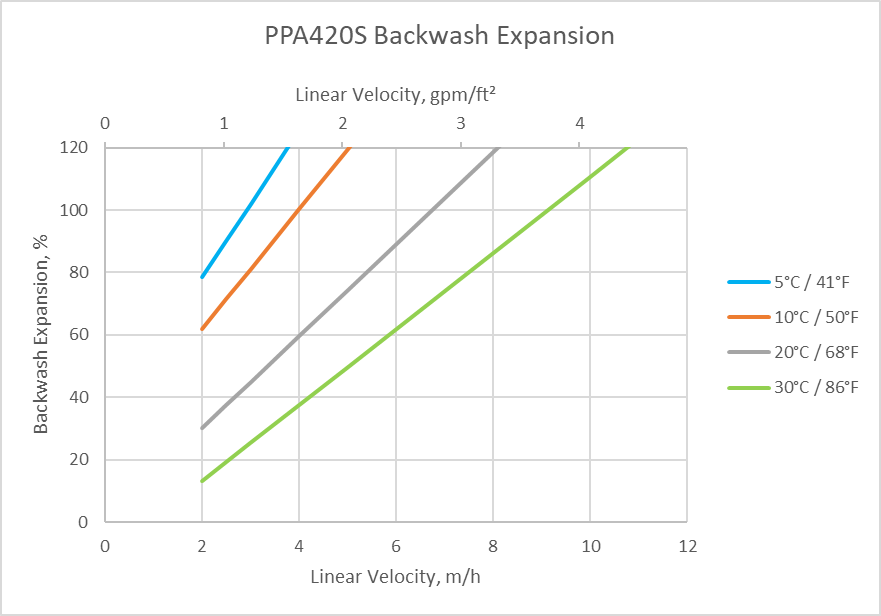
During up-flow backwash, the resin bed should be expanded in volume between 50 and 70% for at least 10 to 15 minutes. This operation will free particulate matter, clear the bed of bubbles and voids, and reclassify the resin particles ensuring minimum resistance to flow. When first putting into service, approximately 30 minutes of expansion is usually sufficient to properly classify the bed. It is important to note that bed expansion increases with flow rate and decreases with influent fluid temperature. Caution must be taken to avoid loss of resin through the top of the vessel by over expansion of the bed.