Affinity Resin Selector
Find the perfect Ecolab
resin for your monoclonal
antibody purification needs.

Find the perfect Ecolab
resin for your monoclonal
antibody purification needs.
As a global leader in resin technology, we develop and manufacture small beads that are used in the most regulated industries in the world to separate, remove or recover very specific elements and compounds.
Learn More
With 40 years of manufacturing expertise and 30 years of regulatory experience, we supply leading separation, purification and extraction technologies to support chromatography applications within the Pharma and Medical space.
Learn more
We are a world leader in resin-based separation, purification and extraction technology, that provides sustainable solutions for our environment, businesses and healthcare.
Learn More
Introduction
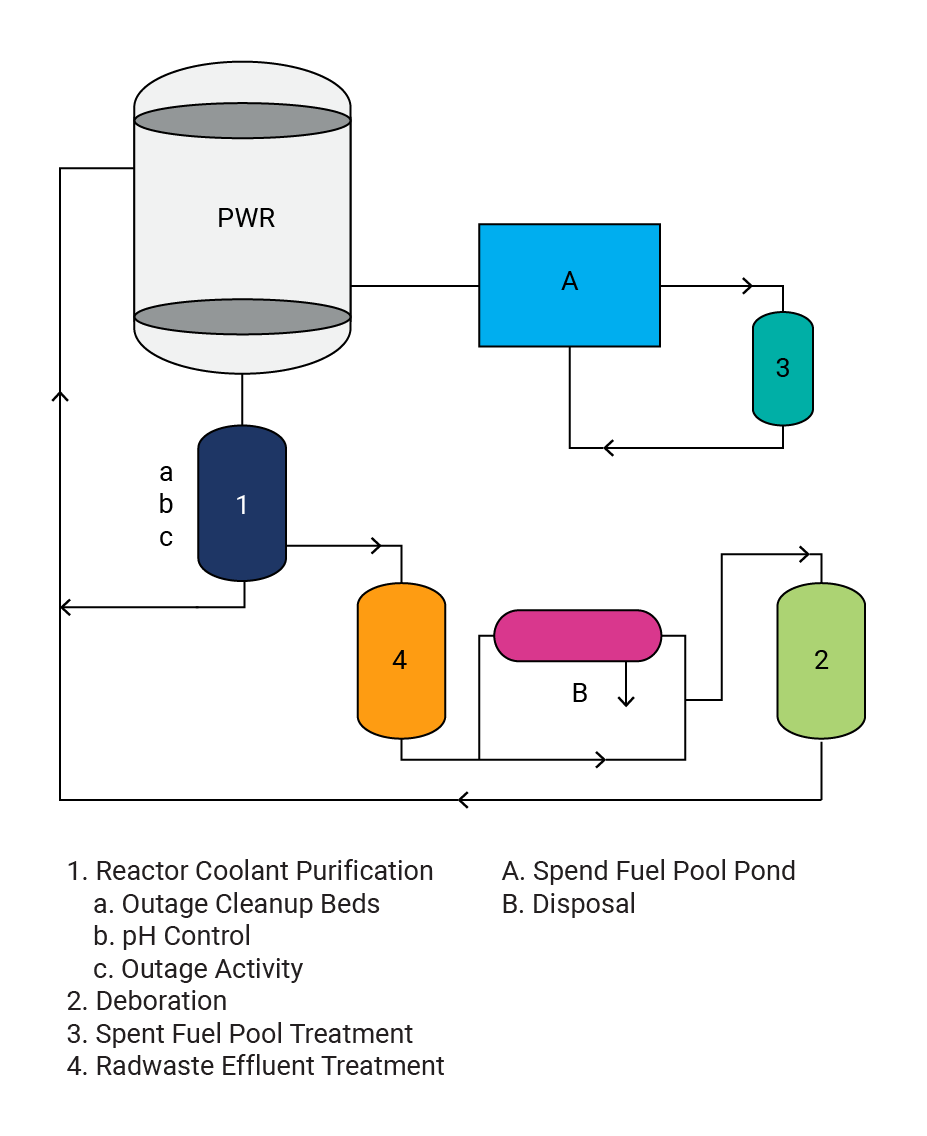
There are three purification systems associated with the primary coolant system of a pressurized water reactor (PWR).
Reactor Coolant Purification
All ion exchange resins used for primary coolant purification have a quality rating and must meet specific criteria for nuclear purity. If not, there will be a risk of impurity leaching. Studies have shown that in the presence of 3,000 ppm boric acid and 2 ppm lithium, an anionic resin containing 800 mg chloride per kg of dry resin produces water containing approximately 50 ppb chloride. Therefore, low-chloride anionic resins must be selected.
The primary circuit coolant water is treated exclusively by the CVCS. This system consists of two to four vessels with different configurations of ion exchange resins. During full power, one tank having mixed bed resin with lithiated cation and borated anion (all anions are borated from boron in the primary coolant) operates to control low-level ionic impurities and maintain a temperature-adjusted pH. Another vessel will contain strong basic anion in the OH form used to control fuel burn rate by removing boron. A third vessel will be loaded with strong acid cation in the H form to remove lithium and further control coolant pH. Near the end of the full power cycle, the refueling outage (RFO) cleanup bed will be loaded with various resin configurations to reduce system radioactivity to a level safe for operators to open the reactor.
Mixed bed resins used in the CVCS include NRW3460XLC and NRW3560XLC (both available in natural 6Li+ and purified 7Li+ forms for full power). The cation resins recommended include NRW160 and NRW1100, and the anion resins recommended are NRW600XLC and NRW700XLC. The XLC class has an extra-low chloride < .05% allowing the bed to be placed into service with startup boron and lithium and controlling the chloride value in the reactor coolant to well below 18 ppb Cl. Macroporous anion NRW5010XLC or NRW5070XLC should be layered on the mixed bed to address colloidal activity during power operation. If a greater capacity is required to remove Co58, Co60 and Cs137, layer the mixed bed with macroporous strong acid cation, NRW160.
Outage Cleanup Beds
Near the end of a power cycle, before a scheduled shutdown, a mixed bed consisting of H+ form cation, OH- form anion (H:OH), and layered macroporous resins NRW160 and NRW5010 should be loaded for refueling cleanup. These resins replace the previous outage bed, which had sat during power generation for isotope decay, then before changeout was sluiced to a spent resin tank (SRT).
During the RFO, the bed is placed into service primarily to remove corrosion isotopes released during the shutdown forced oxygenation step. Chemical adjustments to the primary system carried out shortly after shutdown should reduce “source term” or the activity accumulated in the system. These adjustments include controlling the hydrogen concentration to maintain a reducing phase, followed by hydrogen peroxide to create an oxidizing stage. The addition of hydrogen peroxide will cause iron to precipitate. These steps force corrosion and radioisotopes from the reactor surface and crevices of fuel bundles. Steam generators may or may not be in isolation during the cleanup. However, if recirculating coolant pumps (RCP) remain on, more activity will be released from these areas. Ion exchange beds and filters should reduce radioactive contaminants to the Electric Power Research Institute's (EPRI) action level of 5.0E-2 µCi/gm before outage activities can begin. Due to the limited flow of one cleanup bed in some plants, it is typical for the Li:B bed used during full power to be replaced and operate with the H:OH layered bed in parallel. This doubles the cleanup rate.
Operating at double the flow to reduce the time required to reach the level of action needed works well when CVCS and cleanup beds are used only one cycle. Refueling outage (RFO) beds are H/OH CVCS beds used to clean the primary coolant during an outage.
RFO beds are loaded with a unique configuration (layering) of resins to reduce soluble and insoluble isotopes. For example, RFO beds typically have 20 ft3 of nuclear mixed bed NRW3560 loaded on the bottom, 5 ft3 of high capacity, macroporous cation NRW160 in the middle and 5 ft3 of macroporous anion NRW5010 or NRW5070 to cap the top.
The bottom layer of NRW3560 consists of high-capacity cation (NRW160) and anion resins (NRW600) to polish the coolant. The middle layer of NRW160 removes soluble metals such as cobalt, cesium, iron, nickel and other metal ions in the coolant water.
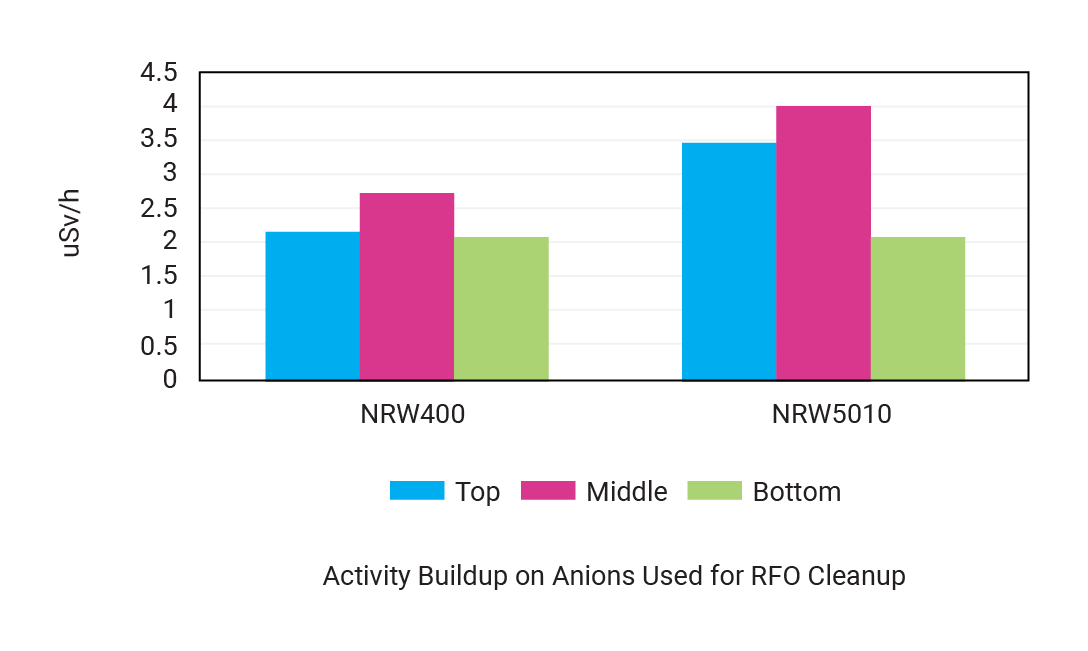
The top layer of NRW5010 or NRW5070 will effectively filter very fine particulates that commonly pass through the cleanup mixed beds. This macroporous anion layer at the top of the bed is efficient at removing particulates below 0.1 µm in size, which would otherwise plug or bypass standard operating filters. Use of these macroporous anions will also favorably impact radwaste cleanup by lowering the post-filtration dose and allowing smaller effective size filters to be used during outage activities, reducing the number of filters used, and assisting in the reduction of source term within the primary system. Currently, there is a push to reduce nuclear waste because of the lack of storage sites. Resins are now being used in more than one cycle, and resin beds short loading.
NRW5010 is a fragile bead with very large pores effective in filtering colloids up to 1.0 micron. If a stronger macroporous bead is required, the anion NRW5070 is available.
pH Control
Primary coolant pH is adjusted upward by adding lithium hydroxide and downward by removing lithium. Since B10 absorbs neutrons and changes into 7Li+, lithium may increase in the circuit during the cycle. This concentration is controlled by routing the mixed bed effluent into a separate CVCS vessel loaded with strong acid cation resin NRW160 to remove predetermined levels of lithium.
Outage Activity
When the reactor cavity coolant has reached the specified activity level, the reactor coolant pumps (RCP) are stopped, steam generators are isolated, and the reactor head is lifted. From this point, the cavity is flooded with water from the reactor or refueling water storage tank (RWST) and refueling begins. This creates a large pool where fuel bundles are manipulated underwater. Some bundles are moved to a spent fuel pool through a refueling canal and continually remain submerged. After refueling is completed, the reactor water is returned to the RWST or released to the radwaste stream for processing before discharge.
Deboration
The term deboration is related to ion exchange systems that will remove boron in a controlled manner. The deboration system removes residual boric acid remaining in the first part of the waste stream by ion exchange before passing to the radwaste processing system. The system may consist of an evaporator or a reverse osmosis system which produces a highly concentrated boron solution. The solution is either recycled back to the primary circuit or directed to a treatment system for solid effluent. Permeate containing boron may be treated with a nuclear grade strong base anion exchanger (NRW7000). The capacity of the anion resin for boron will vary proportionally with the boric acid in the evaporator effluent or reverse osmosis (RO) permeate. When the boron concentration increases, the anion resin operating capacity will increase.
Spent Fuel Pool (SFP) Treatment
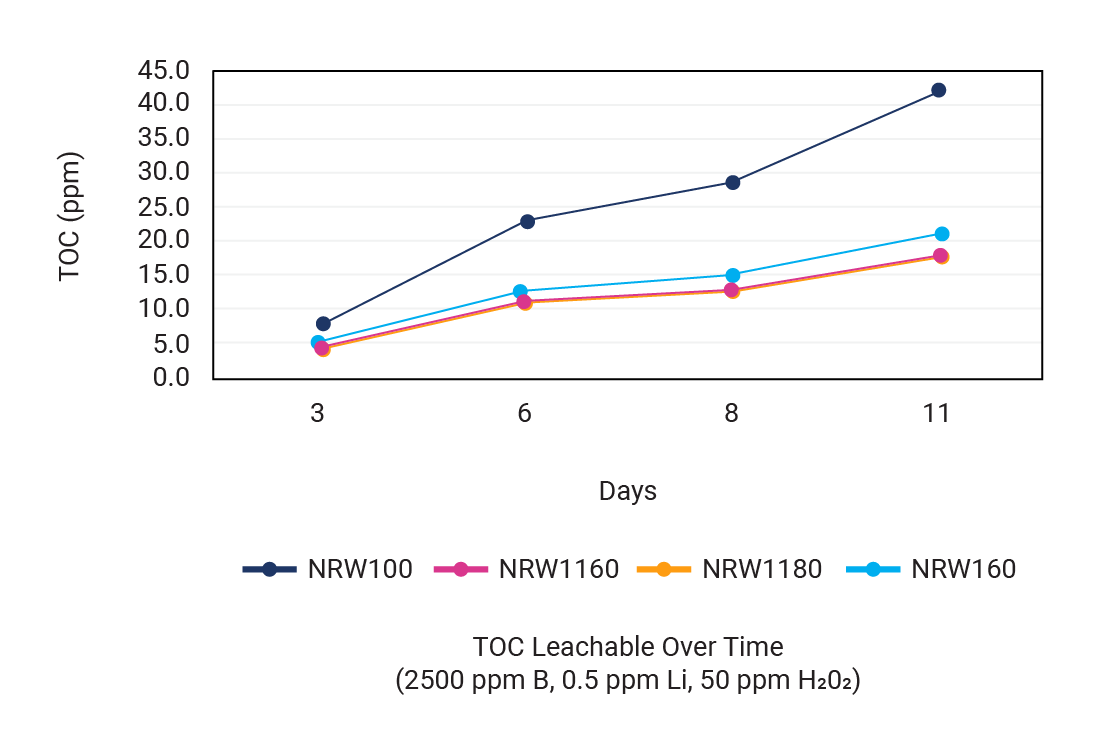
There are generally three pools in a nuclear power plant: the reactor water cavity (RWC), the SFP, and the reactor water storage tank (RWST). The RWC is the pool created when the reactor cavity is flooded with water from the RWST. During the entire cycle, the RWST tank refills the RWC during the outage, the SFP and — during an emergency shutdown — refills the Cold Leg Accumulators (CLA). The CLA is a pressure vessel that will discharge, in the event of pressure loss, high borated water into the cold leg piping feeding the reactor vessel and assists in the shutdown of the nuclear reaction. Purification of the RWC and the SFP is carried out by a spent fuel pool demineralizer, which uses a mixed bed of strong acid cation resin and strong base anion resin (NRW3560 or NRW3670). Peroxide generated by radiation from the exhausted fuel contributes to oxidative attack on the cation resin, which results in the release of sulfates. The highly cross-linked macroporous cation resin NRW160 (found in NRW3560), gel cation NRW1160 (NRW3660), and NRW1180 tolerate this oxidative condition better than lower cross-linked resins. Sediments are easily disturbed during fuel movement, causing clarity to deteriorate and turbidity and increasing radiation levels. Macroporous anion resins NRW5010 or NRW5070 assist in reducing turbidity and associated radioactivity when layered on top of the mixed bed resin. If fuel bundles are moved from the fuel pool and transported to dry storage in special storage casks, the SFP demineralizer with an NRW5010 layer on the mixed bed will remove fine particulates that collect on metal surfaces.
Radwaste Effluent Treatment
The radwaste system collects primary circuit let down and the various liquid waste streams originating from the radioactive sections of the power plant. The effluents are filtered before being treated by ion exchangers. Usually, the resin train consists of activated carbon, natural zeolite, a strong acid cation exchanger H+ form (NRW160, NRW1100), followed by mixed bed resins (NRW3240). Some radioactive products are present in colloid form and not captured by conventional resins. Adding a layer of the macroporous anion resin NRW5010 or NRW5070 on top of the lead strong acid cation bed will effectively address this type of contaminant. The conventional radwaste mixed bed resin may be replaced with the higher-capacity mixed bed, NRW3560. It should be noted that the resins used for the treatment of wastewater do not necessarily have to be of nuclear quality. They must, however, be highly regenerated to maximize loading of activity.