Affinity Resin Selector
Find the perfect Ecolab
resin for your monoclonal
antibody purification needs.

Find the perfect Ecolab
resin for your monoclonal
antibody purification needs.
As a global leader in resin technology, we develop and manufacture small beads that are used in the most regulated industries in the world to separate, remove or recover very specific elements and compounds.
Learn More
With 40 years of manufacturing expertise and 30 years of regulatory experience, we supply leading separation, purification and extraction technologies to support chromatography applications within the Pharma and Medical space.
Learn more
We are a world leader in resin-based separation, purification and extraction technology, that provides sustainable solutions for our environment, businesses and healthcare.
Learn More
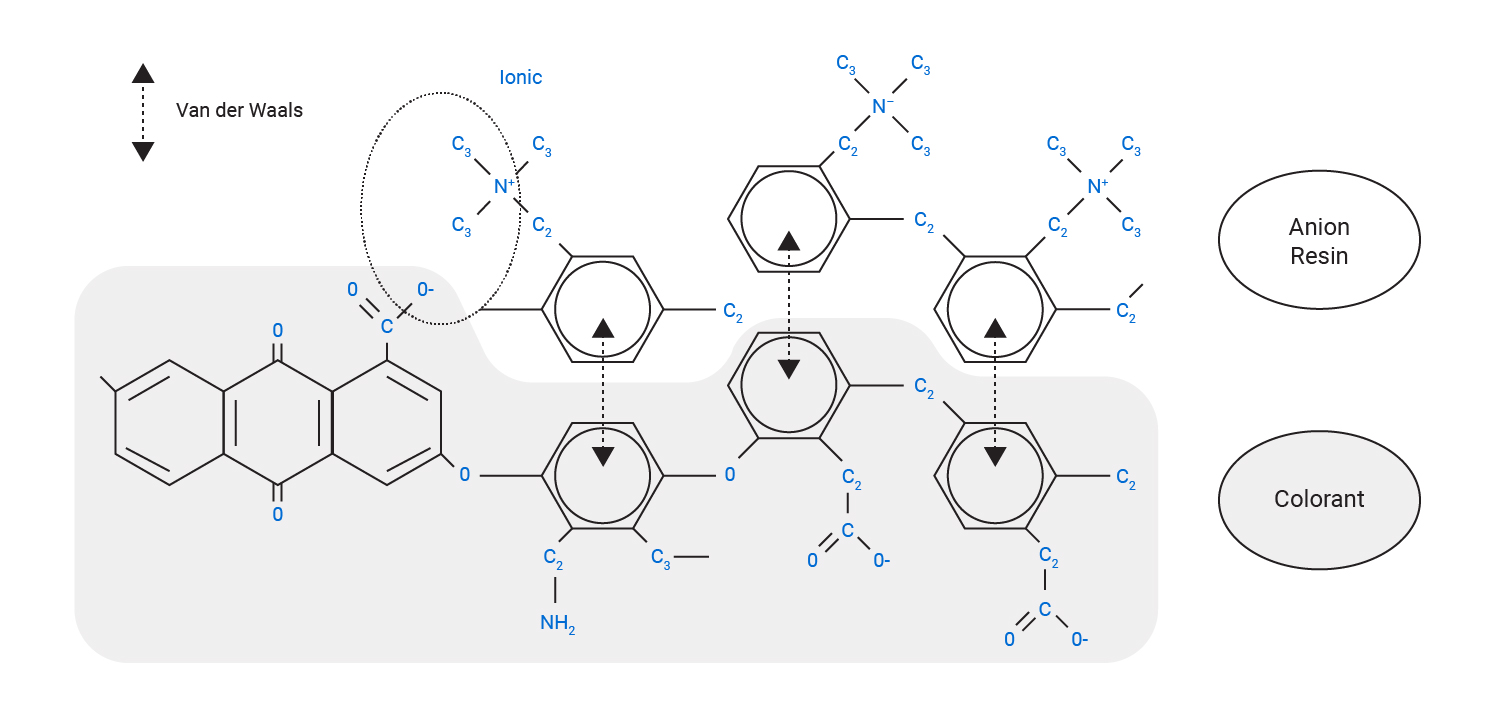
Two main mechanisms are involved in sugar colorant fixation to strong base anion exchange resins; ionic bonding between anionic colorants and the resin’s fixed charges, and hydrophobic interaction between non-polar parts of the colorant and the styrene-divinylbenzene resin matrix.
Since most sugar colorants have an anionic nature, being charged negatively, strong base anion resins are efficient decolorizers. However, both mechanisms can affect the same colorant molecule in amplified ionic binding. Carboxylic acids and phenols of low molecular weight are fixed by chemical reaction and by molecular interaction with the resins. Large, high molecular weight organic acids can be bound chemically and by interaction at several different resin sites, reinforcing the binding and making their removal from the resin difficult.
Colorants fixed to resin can switch from one mechanism to the other during regeneration. This may explain the high efficiency of styrenic resins as sugar decolorizers when new, as well as the difficulty of removing colorants during regeneration and the rapid decrease of their efficiency in use.
About 10% of the resin ion exchange capacity is actively involved in decolorization, most probably on the surface of the resin beads. It has also been suggested that most of the decolorization of strong base polystyrenic resins (except at high pH) occurs in the resin structure and not at the functional groups.
This is due to the relatively high electronic density in the aromatic structure, which is attractive for non-polar and electrophilic species. At high pH values, ion exchange mechanisms will predominate.
Adsorption of sugar colorants to ion exchange resins are governed by the following:
 Combination of adsorption and ion exchange depending on color body molecular size. Note: The carbon subscripts (C) refer to the number of hydrogen (H) atoms attached to the carbon.
Other Decolorization Mechanisms to be Considered
Colorants vary in molecular weight, and therefore, porosity of the decolorizing media is a key parameter. The molecular weight of sugar colorants varies from 30 kDa to 1000 kDa for cane sugar. To achieve good decolorization kinetics, important parameters are the ratio of micropores, meso pores, and macropores. This illustrates why the decolorization of sugar juices are carried out at a relatively low flow rate.
Hydrophobic Effect
Activated carbon has a virtually non-polar surface whereas polymeric adsorbents have a polarity (acrylic matrix decolorizers are more hydrophilic than the styrenic ones). The colorants are essentially hydrophobic (not highly soluble in water) and will tend to be adsorbed on the hydrophobic part of the adsorption media. This is presumably the main mechanism in color removal. Pure polymeric adsorbents have demonstrated their effectiveness in removing colored species (high hydrophobicity, high surface area). Being not functionalized, they can operate in a salty environment knowing their osmotic stability results in a very long-life time allowing them to withstand very aggressive conditions (temperature, pH, concentration, and oxidant media). They are very effective in polishing steps and can be considered as an alternative to powdered activated carbon.
Van der Waals Forces Effect
The Van der Waals forces cause chemical groups already in contact with each other to experience an attractive pull. This results from a temporary dipole formation. Van der Waals force bonding is the main adsorption mechanism taking place on the surface of activated carbon.
Ion Exchange
Colorants exhibit mostly anionic behavior at alkaline pH and thereby can be exchanged against the mobile chloride ions. This results in an ionic bond (electrostatic attraction) between the resins positively charged ionic group and the negatively charged part of the colorant. However, this mechanism is not the predominant one in color removal.
Hydrogen Bonds
Hydrogen bonds are electrostatic attractions that occur between molecules in which hydrogen is in a covalent bond with a highly electronegative element (oxygen or nitrogen). The main mechanism for granular activated carbon adsorption is the Van der Waals (or London) force binding. The ion exchange resin decolorization process is a combination of several phenomena (figure below) such as ion exchange, hydrogen bonds and London forces.