Affinity Resin Selector
Find the perfect Ecolab
resin for your monoclonal
antibody purification needs.

Find the perfect Ecolab
resin for your monoclonal
antibody purification needs.
As a global leader in resin technology, we develop and manufacture small beads that are used in the most regulated industries in the world to separate, remove or recover very specific elements and compounds.
Learn More
With 40 years of manufacturing expertise and 30 years of regulatory experience, we supply leading separation, purification and extraction technologies to support chromatography applications within the Pharma and Medical space.
Learn more
We are a world leader in resin-based separation, purification and extraction technology, that provides sustainable solutions for our environment, businesses and healthcare.
Learn More
Cost:
One advantage of ion exchange resins as sugar decolorizers is the economy. The costs are considered to be about half those of traditional granular carbon or bone char methods. These costs comprise resin, carbon and char usage, energy, labor, maintenance and sugar losses. Water use decreases from 30% to 50% per sugar output. Energy savings arising from the use of resins come mostly from lower hot water requirements, and lower volumes of sweetwater produced with consequent reductions in energy needed for heating and concentration, respectively. Brine is inexpensive, and regeneration cost is low, so resin decolorization is a low-cost alternative to traditional methods such as activated carbon or bone char.
Equipment Size:
Flow rate is greater through resin than alternative materials and requires a less bulky apparatus for given liquor flows. Also, shorter retention times reduce sucrose degradation during decolorization. As regeneration can be performed inside resin columns, no special handling systems or other equipment for regeneration are needed.
Automation:
The resin process is easily automated, and the liquor and adsorbent are always contained inside a closed vessel, so the process is more hygienic than other decolorization processes.
Ion Exchange Resin Adsorption Mechanism
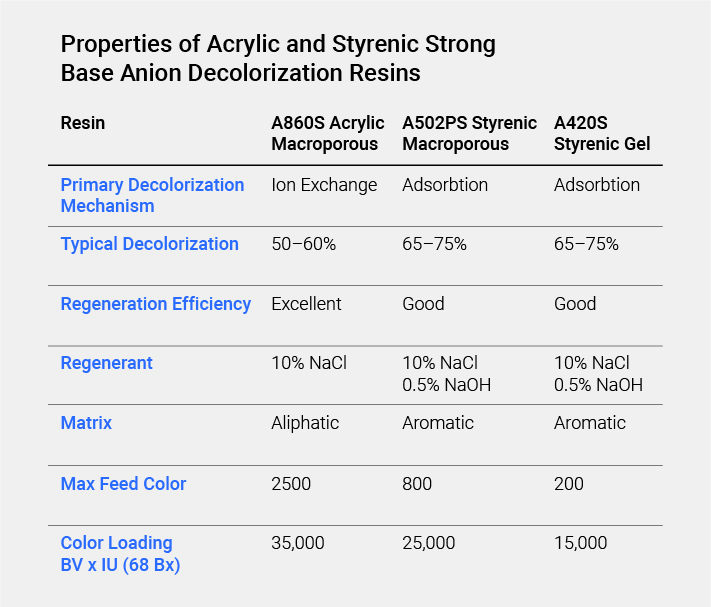
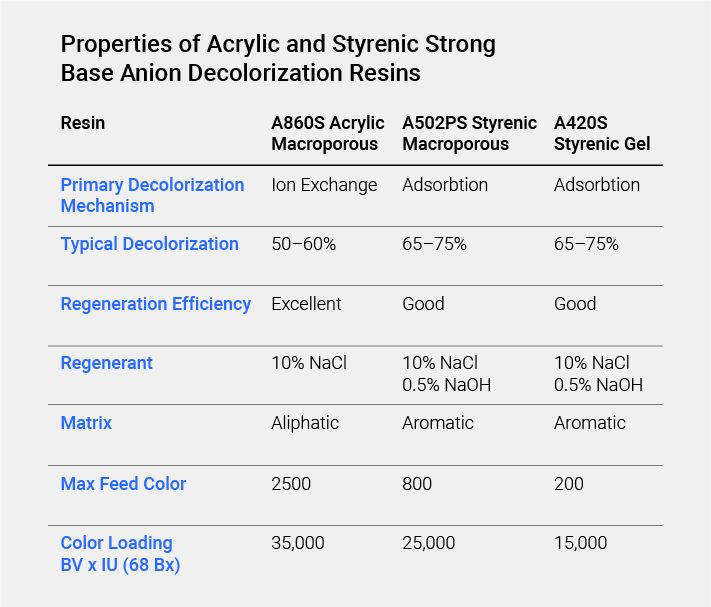
This table provides a comparison of the three different anionic decolorization resins primarily being used today, macroporous acrylic, macroporous styrenic and gelular styrenic.