Purolite Jetted A50 HipH – Addressing Host Cell Protein Challenges in Monoclonal Antibody Production
Yair Peres, PhD, Field Application Scientist at Purolite
Host cell proteins (HCP) have a serious impact on downstream processes in antibody manufacturing, and their removal presents a significant obstacle in antibody purification. To address this issue, Purolite has developed Jetted A50 HipH, designed to elute at higher pH, thereby reducing both aggregation and host cell protein levels as discussed in this paper.
Host Cell Proteins and Their Impact
Host cell proteins (HCP) introduce many challenges in monoclonal antibody downstream manufacturing. HCP are expressed during the production of biotherapeutics by the host organism, typically by Chinese Hamster Ovary (CHO) cells. This standard mammalian host cell produces over 6000 proteins, of which HCPs are directly secreted into the cell culture fluid or released from lysed host cells during culture and harvest[1]. The presence and levels of HCP depend on various factors including host cell type, clone type, the product being expressed, and upstream conditions. HCP levels in CHO Clarified cell culture fluids (CCFs) of 30 monoclonal antibodies range from 5 to 6 logs ppm, showcasing the complexity of HCP in the process feed stream and creating considerable challenges for downstream processes[2].
HCP Characterization and Regulation
Various methods are employed to measure and characterize HCP, such as immunoassays (ELISA) and mass spectrometry. HCP levels are considered a critical quality attribute – while regulatory agencies do not specify allowed levels of HCP in the final drug product, conventional practice aims to limit the levels of HCP to a maximum of 100ppm due to potential adverse immune responses in patients. Proteolytic HCP may also impact product quality of the final drug by cleaving the product during storage, highlighting the importance of reducing HCP to the lowest reasonable level. Previous studies have found that marketed monoclonal antibodies and derivatives exhibit an average HCP level of 20 ppm, indicating an ongoing effort to manage HCP levels[3].
Approaches to Mitigate HCP Challenges
Industry and regulatory standards utilize prior knowledge and a Quality by Design (QBD) approach to ensure product quality and manage risks, as guided by the ICH Q6B guideline. Unit operations upstream and downstream are designed to decrease HCP presence or remove it from the feed stream[4]. For instance, post-harvest clarification utilizing depth filters can effectively remove a subset of HCP through size exclusion or charge interaction.
Protein A Affinity Chromatography and HCP Removal
Protein A affinity chromatography, commonly used in monoclonal antibody manufacturing, offers selective capture of target molecules while allowing other impurities to flow through. Modified pH washes and additives have been utilized to increase HCP removal during the protein A step, but residual HCP quantities, including "difficult to remove" HCP, have been reported to persist, potentially due to non-specific binding to chromatography media or co-elution with antibodies[5].
Furthermore, the acidic elution (pH 3.5-4) commonly employed to release antibodies from Protein A resins increases the propensity for protein aggregation, particularly in Bi-Specific Antibodies (BsAb), Fc-fusions, and other mAb derivatives [6, 7]. Aggregation has been identified as a key factor in the persistence of HCP, complicating efforts to clear aggregates with current methodologies[4, 8].
Decreasing the levels of HCP, aggregates and other impurities in the protein A eluate pool alleviates the challenge in purification and enables a lower chromatography matrix (resin, membrane) volume for clearing HCP impurities in subsequent steps. In a conventional three-step chromatography, process aggregate removal is typically restricted to a single polishing step, thus
reducing their level also enhances process robustness [9, 10].
Thus, mitigating protein aggregation during the protein A capture step can increase product yield, enhance product quality, and improve process economy.
Praesto Jetted A50 HipH for Enhanced HCP Removal
Purolite's Praesto Jetted A50 HipH, a novel protein A-based agarose resin, addresses these challenges by enabling the purification of Fc-containing molecules under mild conditions. The design of the Praesto Jetted A50 HipH protein A ligand introduces enhanced pH sensitivity to the ligand -antibody binding, allowing for the disruption of the protein A-Fc interaction and dissociation of the product from the resin at a higher pH compared to traditional protein A resins. Furthermore, the milder elution conditions preserve the integrity of acid-labile proteins, mitigate aggregation, and can leave tightly bound impurities adsorbed by the resin thereby contributing to an increase in product purity from both product-related and process-related impurities, including HCP.
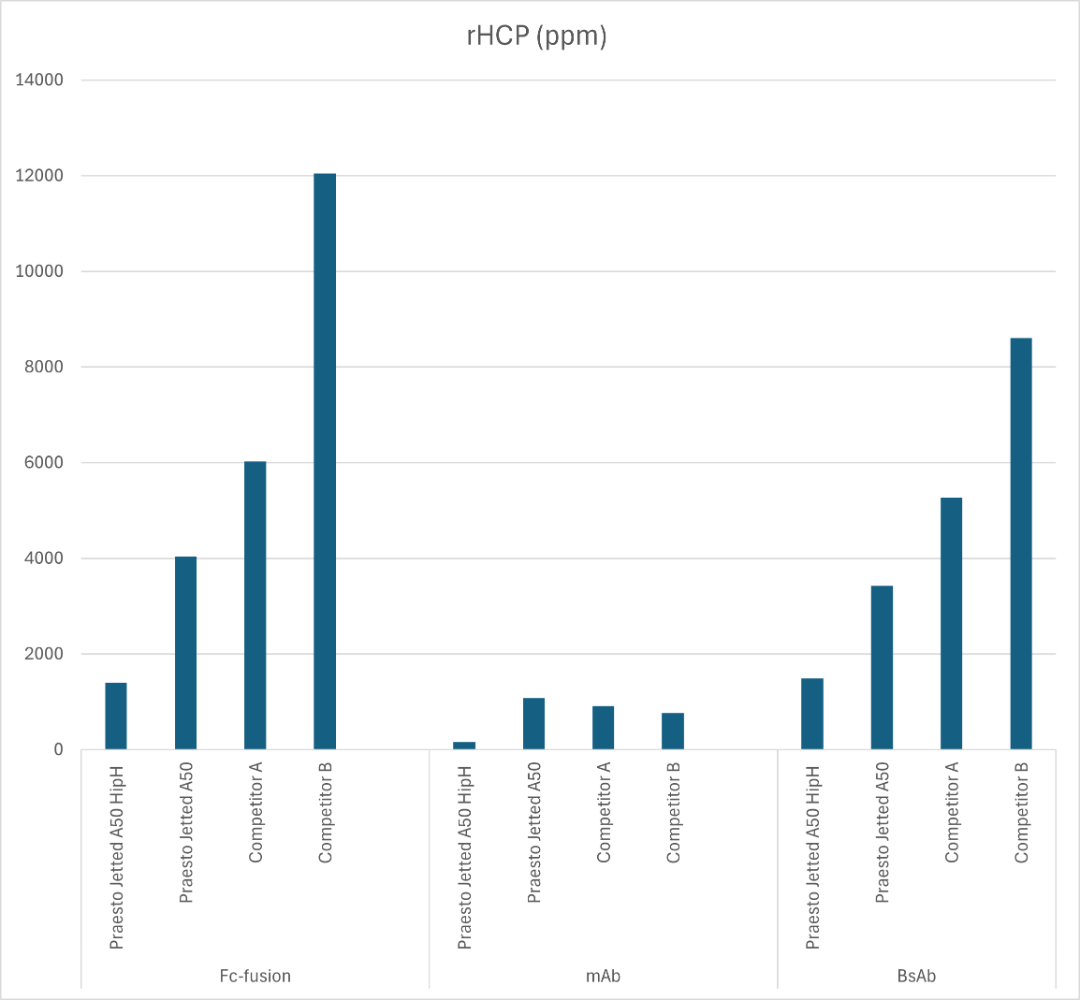
Studies using Praesto A50 HipH resin as a capture step across molecular modalities measured by ELISA is shown in figure 1, demonstrating a 2.3 to 8.6 fold increase in HCP clearance compared to a traditional protein A resin (competitor A), and a high performance protein A resin (competitor B).