Affinity Resin Selector
Find the perfect Ecolab
resin for your monoclonal
antibody purification needs.

Find the perfect Ecolab
resin for your monoclonal
antibody purification needs.
As a global leader in resin technology, we develop and manufacture small beads that are used in the most regulated industries in the world to separate, remove or recover very specific elements and compounds.
Learn More
With 40 years of manufacturing expertise and 30 years of regulatory experience, we supply leading separation, purification and extraction technologies to support chromatography applications within the Pharma and Medical space.
Learn more
We are a world leader in resin-based separation, purification and extraction technology, that provides sustainable solutions for our environment, businesses and healthcare.
Learn More
| Structura polimerica | Copolimer gel polistirenic reticulat cu divinilbenzen | |
| Aspect | Perle sferice | |
| Grupari functionale | Grupari quaternare de amoniu tip I | |
| Forma ionica | forma OH- | |
| Capacitatea totală (min.) | 1.0 eq/L (21.8 Kgr/ft³) ( forma OH- ) | |
| reținerea umidității | 60 - 70 % ( forma OH- ) | |
| diametru mediu | 705 ± 55 µm | |
| coeficient de uniformitate (max.) | 1.2 | |
| < 300 µm (max.) | 0.3 % | |
| < 850 µm (max.) | 90 % | |
| granule întregi (max.) | 95 % | |
| conversie (min.) | 90 % ( forma OH- ) | |
| Dilatare reversibilă, Cl- → OH- (max.) | 30 % | |
| densitate specifică | 1.07 | |
| Greutate de transport (aprox.) | 655 - 690 g/L (40.9 - 43.1 lb/ft³) | |
| Limita de temperatură | 100 °C (212.0 °F) ( forma Cl- ) | |
| Limita de temperatură | 60 °C (140.0 °F) ( forma OH- ) | |
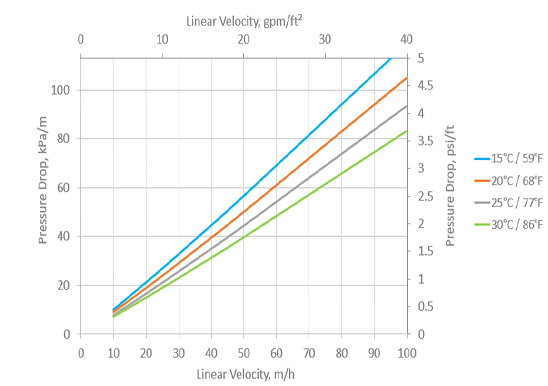
The pressure drop across a bed of ion exchange resin depends on the particle size distribution, bed depth, and voids volume of the exchange material, as well as on the flow rate and viscosity of the influent solution. Factors affecting any of these parameters— such as the presence of particulate matter filtered out by the bed, abnormal compressibility of the resin, or the incomplete classification of the bed—will have an adverse effect, and result in an increased head loss. Depending on the quality of the influent water, the application and the design of the plant, service flow rates may vary from 10 to 40 BV/h.